

You are in:
- Home
- Communication
- Press office
- Press releases
- Archive
- The transport interchanges staff are trained in cardiopulmonary resuscitation
The transport interchanges staff are trained in cardiopulmonary resuscitation
The Community of Madrid has made all regional transport interchanges, cardio-protected areas, because of install in all of them semiautomatic defibrillators and continuously perform training for all staff working in these infrastructures, techniques in cardiopulmonary rehabilitation.
For this reason, the Consorcio Regional de Transportes de Madrid has received the award 2013 of the Association "HC Second Chance", in recognition of the initiatives taken by the agency to the possibility of a life-saving intervention for a person in cardiac arrest.
Keep in mind that the exchangers are places of great influx of people, used annually by 234 million passengers and a swift action of the infrastructure personnel can save a citizen of a cardiac arrest.
Thus, employees in Plaza Castilla, Avenida de América, Príncipe Pío, Moncloa and Plaza Elíptica receive specific training to perform the tasks first aid and the use of existing semi-automatic defibrillators present in these facilities clearly marked. The managing director of the Consorcio Regional de Transportes de Madrid, Jesús Valverde, came today to check the development of this training at Plaza Elíptica exchanger, where he attended a demonstration.
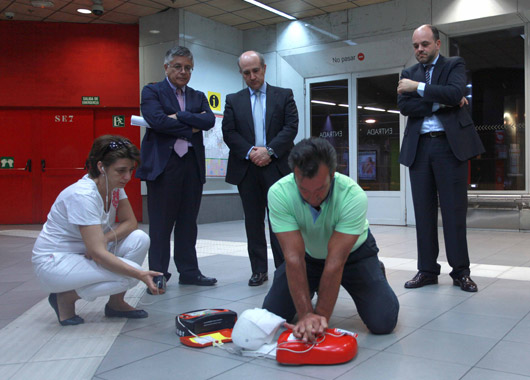
Elíptica exchanger, where he attended a practical demonstration.
In total, about 80 employees have received basic lessons on how to act in case of a cardiac emergency inside the exchangers. Participants in these courses learn to detect when a person requires emergency health care and when not to, when to alert the medical staff and what data to provide, to be able to cope with a series of simple, basic techniques of resuscitation and how to use the defibrillation as a fundamental tool to save a victim of heart failure.
Protocols with SAMUR
Valverde noted that the exchangers are the first transport system installations cardio-protected and reiterated its commitment to remain a leader in this field. So he recalled special protocols these infrastructures have with SAMUR Civil Protection to handle any emergency.
In this way, in the exchangers are enabled parking spaces exclusively for mobile health units and has implemented a warning mode and direct communication between the command post of the exchanger, the Center for Integrated Transport (Citram) of the Consorcio de Transportes de Madrid and SAMUR.
"So far, confirmed the regional manager, has not been necessary to use any defibrillator at interchanges, but why not, let's get to work so that these areas are safe and offer all possible assistance in the event of an emergency health ".